
This ABM guide is a deep dive into building a cohesive enterprise ABM program. We cover everything from what ABM is, to readiness criteria, to sales and marketing alignment techniques, analytics and more. We suggest bookmarking and returning to this guide as needed.
What this ABM guide covers
First things first: Account-Based Marketing (ABM) isn’t new. This guide is meant to provide step-by-step building blocks so you can form a cohesive, strategic program.
At its core, ABM is simple: a focused approach to marketing that involves running highly targeted programs against a defined list of accounts.
There are already countless guides, frameworks, and best practices out there. You can read vendor blogs, explore platforms like Demandbase or 6sense, or even ask ChatGPT or Gemini to generate a playbook for you in seconds. We’ve included some resources at the end of this guide.
So we’re not here to reinvent the wheel.
But marketers have layered on tools and terminology (as we tend to do!) so it can be hard to know where to start. So let’s start with the basics.
What does modern Account-Based Marketing look like?
- A mature B2B marketing strategy
- A full software category (e.g. Demandbase, 6sense, Terminus)
- Even a rebrand (ABX, or account-based experience)
Underneath it all, ABM is about focus, alignment, and relevance.
We still hear companies say “we want to test ABM.” We’ve witnessed a variety of tactics and approaches to ABM with varying levels of success: some programs completely fail, while others become breakout growth channels.
More often than not, the difference isn’t the tactics, but the foundations behind them. So what are the foundations of a strong ABM strategy?
Here’s a practical, tactical guide on how to build an ABM strategy from scratch — based on what actually works in the real world.
In this ABM guide, you’ll learn:
- What account-based marketing is and how it helps
- When ABM makes sense (and when it doesn’t)
- How to create an ABM strategy with defined tactics, step-by-step
- Common mistakes that kill ABM programs early
What is Account-Based Marketing (ABM)?
Account-Based Marketing (ABM) is a B2B marketing strategy where sales and marketing teams work together to target high-value accounts with personalized campaigns.
Instead of generating a high volume of leads, ABM focuses on:
- Specific companies (target accounts)
- Key decision-makers and stakeholders
- Personalized messaging and experiences
In simple terms: ABM is targeted marketing aligned with sales to win high-value deals.
Benefits of Account-Based Marketing (ABM) for sales
When implemented correctly, an ABM strategy with defined tactics can drive:
- Higher deal sizes
- Better win rates
- Shorter sales cycles
- Stronger sales and marketing alignment
- More efficient marketing spend
This combination of highly focused marketing and shared ownership of pipeline and revenue leads to larger contract values, increased conversions, and accelerated decision-making.
When should your GTM teams use ABM?
Whether ABM or AI, we see a lot of teams eager to test the latest marketing strategy. We get it, these hype cycles can feel like you’re missing out if you’re not doing it!
But remember: ABM is just an approach to marketing. And that means ABM isn’t for every company.
ABM should be used for higher-value accounts and longer B2B deal cycles — otherwise you’re just doing regular marketing. ABM is particularly well suited to industries with long procurement cycles and multi-stakeholder buying committees.
This includes enterprise software, professional services, and industrial manufacturing.
You should consider ABM if:
- You sell high-ticket B2B products or services with longer deal cycles
- You’re targeting strategic, enterprise or 6-figure mid-market deals
- You have a defined Ideal Customer Profile (ICP)
You should NOT use ABM if:
- You rely on high-volume, low-cost conversions
- Your sales and marketing teams are not aligned
- You’re still validating your ICP or positioning
ABM best practices: what the strongest programs have in common
The strongest programs have three core pillars in common. First is a strong adherence to cross-functional communication and relationships across sales, GTM, and RevOps. Second is a coherent, agreed-upon target list, worked with tactics that are aligned cross-functionally.
Third is a multi-channel approach, leveraging a variety of channels instead of relying on a single tactic to drive results.
How to create an enterprise ABM strategy (in 6 steps)
Step 1: Ensure ABM readiness
Before launching an ABM strategy or investing immediately in software, make sure you have the right foundations in place.
Key marketing readiness criteria
1. Budget and expectations
Can you afford to test ABM? ABM requires more investment and time than traditional demand generation. If you’re targeting six-figure deals, small campaign budgets won’t deliver results. We recommend assigning at least 10% of your budget to ABM motions.
2. Reporting infrastructure
You’ll need alignment with RevOps and/or Marketing Ops, and executive buy-in for marketing to test ABM.
You should be able to track:
- # of contacts engaged with sales
- # of net new ICP contacts
- # of qualified responses
You’ll also need existing benchmarks on:
- # of opportunities created
- Deal velocity
- Average deal size/length (pipeline value)
- Average win rate
3. Strong fundamentals
Your ICP, messaging, product-market fit, and sales process must be aligned and clear. This is the most common reason why ABM tactics fail. ABM is a team game: you need marketing and sales running like an assembly line and rowing in the same direction, otherwise you’re wasting your budget.
4. Content capabilities
One of the most common roadblocks to launching a successful ABM motion is content. Generic content won’t work, because ABM needs to be personalized for the audience you’ve identified. If it’s not, you’re just running a regular marketing campaign.
For enterprise teams:
With more resources, it’s lower risk to invest in an ABM platform upfront.
- Start with a basic enterprise ABM platform, connecting it to your CRM and marketing automation
- Then, hire a senior marketer with ABM experience so you can hit the ground running
- If done correctly, you can implement the ABM platform and go-to-market with your first program within a quarter — sounds ambitious, but it’s doable!
Step 2: Align sales and marketing
So you’re feeling ready to activate ABM within marketing, but not so fast! Sales and marketing alignment is the foundation of any successful ABM strategy.
At a minimum, your Director of Demand Generation and Director of Sales should be working as partners, leading their teams in the same direction with a shared plan.
What alignment includes:
- Shared ABM goals and expectations
- Defined roles and responsibilities (RACI model)
- Agreed workflows for outreach and follow-up
- Ongoing communication, feedback, and documentation
In enterprise ABM, marketing is an extension of sales, not a separate function.
For enterprise marketing teams:
Alignment often takes longer in enterprise environments due to added complexity and stakeholders.
- If sales is leading the initiative, alignment is typically faster, since they’re already invested
- The same applies if the push comes from the CRO or CEO
- If ABM is marketing-led, you’ll need to identify a sales leader who believes in the approach and is willing to champion it internally
Step 3: Define your ICP and select target accounts
Now that we’re all aligned, it’s time to identify the Ideal Customer Profile (ICP) and target accounts.
There are many ways to do this, and the resources we’ve shared at the end of this guide have a lot of examples. Here are the basic methods.
Types of ABM strategies:
- 1:1 ABM - highly personalized (best for mature programs)
- 1:few ABM - small groups of similar accounts
- 1:many ABM - scaled personalization
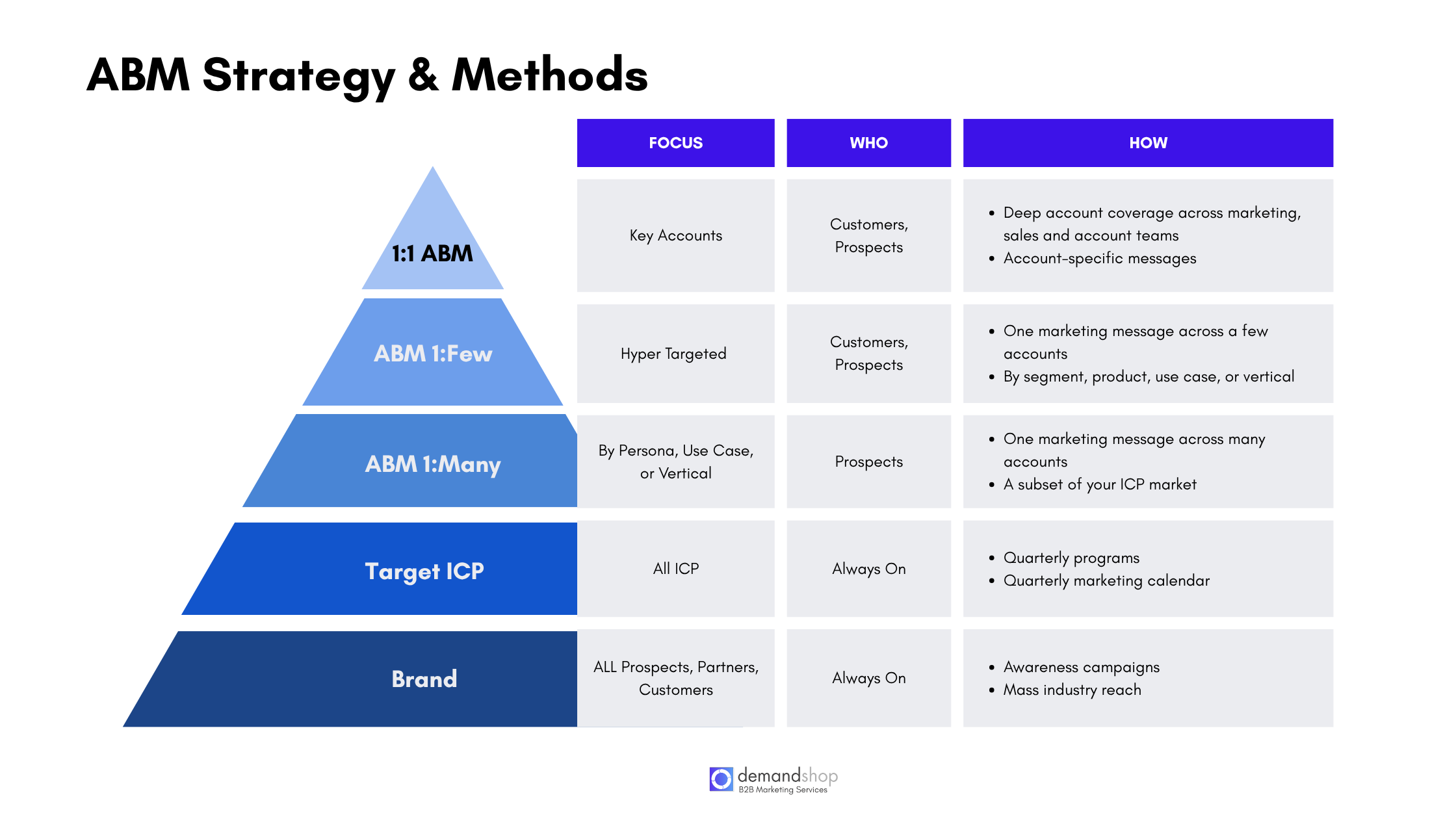
Many teams should start with 1:few or 1:many ABM, depending on your product, ICP, and average deal length. Here are 4 general recommendations when it comes to picking a list:
Ways to segment enterprise target accounts:
- By industry (vertical marketing): you have case studies, proof points, the product, and confidence in messaging
- By use case (pain-point driven): you have clear solutions, proven use cases, and confidence in your sales talk tracks
- By company size: your product or solution varies by company size and can act as separate segments
- By persona (role-based targeting): you have core solutions and messaging that differ by persona — this only works if you have personalized content for each role
For enterprise teams:
A fifth option is by competitor based on intent data. If you’re using an enterprise ABM platform (e.g. Demandbase, ZoomInfo, 6sense), you should be able to access intent data and generate competitor-specific campaigns.
How many accounts should you target?
List sizes depend on your niche, but the sweet spot to test is 100–300 target accounts maximum, and fewer for 1:few and 1:1.
This provides enough scale without losing personalization. Validate the list with AI tools and your sales team before you start testing.
Step 4: Map the buying committee and personalize messaging
Now that you have your list, it’s time to map the buying committee and develop the tactics and strategy. ABM can help identify the decision-makers, map out the organization chart with SDRs, and directly go after known contacts.
In B2B ABM, you’re targeting an entire buying group, not a single lead. For ABM campaigns, you must identify which parts of the buying committee you’re trying to influence first.
Key stakeholders may include:
- Decision-makers
- Influencers
- End users
- Procurement and/or Finance
If you don’t know all the parts of the buying committee, ABM can help validate this — sales usually have good hunches that marketers can help validate and expand on.
Make sure you have personalized messaging for each role. This is where product marketing can be a key partner.
Best ABM tactics to map enterprise buyer groups:
- Identify key roles within each account
- Understand their priorities and pain points
- Tailor messaging by persona
- Add a campaign angle
What makes a strong ABM campaign?
Today’s B2B landscape is noisy. SDRs are calling your personal cellphones. Companies are putting webinars in your calendar, hoping you don’t notice. How do you cut through the noise in a way that’s authentic and ethical?
Strong ABM campaigns often include:
- A clear theme or narrative
- A specific problem or use case
- Creative differentiation
Creative differentiation is our personal favorite tactic: surrounding your campaign with a brand message and a unique, catchy idea makes it more memorable and effective.
This involves homing in on a universal pain point that your ICP is going through — again, it’s back to fundamentals of understanding your prospects, customers, and value proposition.
For enterprise marketing teams:
If you have an enterprise ABM platform, you can build buying groups within the product and it can inform your team on any contact gaps.
Step 5: Execute multi-channel ABM campaigns
A successful ABM strategy requires coordinated tactical execution across multiple channels.
Research shows that B2B deals often require hundreds of touchpoints before closing, and advertising usually accounts for over 50%.
Essential ABM tactics:
1. Air cover advertising
Recent research by Demandbase Labs shows that the highest sales conversion rates happen when sales activity is backed by air cover from coordinated advertising. This involves targeted campaigns across platforms like LinkedIn or Meta/Instagram designed to build awareness and engagement across your account list.
2. Account personalized content
Webinars (ideally with customer speakers), case studies, playbooks, and video content tailored to specific industries, personas, or use cases.
And remember: this content shouldn’t work for your entire prospect base — otherwise, it’s not an ABM motion. The content should be ultra specific for the identified ICP.
3. SDR outreach
Direct, personalized outreach aligned with campaign messaging. This ensures consistency across all touchpoints, from direct-response ads to emails to sales conversations.
Extra tip: Compensate your SDRs appropriately. These are long deals, so opportunities won’t be opening immediately. You need to reward and incentivize SDRs to keep hunting.
4. Events (virtual and in-person)
High-impact engagement opportunities are a key driver for pipeline creation. Sales and subject matter experts are in the same room as your prospects having valuable discussions.
5. Dedicated account-oriented landing pages
No generic website traffic to your homepage — build personalized experiences for target accounts, focused on their specific challenges, use cases, and solutions. Think of it like a micro-site of interactive content.
For enterprise marketing teams:
Speed is often the killer at enterprise companies: more people, more teams, and more operational processes are required to launch a single new motion and campaign.
One solution is to create a tiger team for this motion: an assigned marketing ops or RevOps lead, a marketer, and a sales team member, all responsible for the strategy and execution of this motion. The ops team member will ensure that the program is launched seamlessly and within the right timeframe.
Step 6: Measure, optimize, and scale your ABM
Congrats! Your ABM campaign has gone live — but you’re not done yet. The final step is measuring success, optimizing, and scaling.
It’s common for mid-market and above revenue teams to struggle with disconnected data and reactive marketing. On top of that, every company will have their own revenue challenges and different funnel metrics that they’re trying to improve. There’s no “one size fits all” solution.
Generally, measuring ABM success requires a mix of metrics:
Account engagement metrics
- Website visits
- Content engagement
- Meetings booked
Coverage metrics
- Number of stakeholders engaged
- Buying group completeness
Pipeline metrics
- Opportunities created
- Pipeline velocity
- Deal progression
Revenue metrics
- Win rate
- Average deal size
- ROI
Make sure to use average benchmarks you’ve collected from earlier to compare before and after. Feedback from sales and those speaking directly to your prospects is also critical.
Don’t forget about qualitative data:
- Are conversations improving?
- Are more prospects educated?
- Are deals progressing faster?
- Has the program revealed new campaign opportunities?
And for accounts that closed-lost with ABM support, what were the reasons? All of this information will reveal valuable competitive intel that will inform product teams on where to improve.
When to scale your ABM strategy
ABM is a long-term investment. Most programs require multiple quarters before scaling due to the nature of the deal length.
The key is not to scale by volume, but by expanding into new segments (verticals, use cases, personas).
Common ABM mistakes to avoid
- Launching ABM without proper readiness
- Misalignment between sales and marketing
- Targeting too few or too many accounts
- Focusing on vanity metrics
- Expecting immediate results
- Investing in ABM software too early
If you’re curious, we cover more of these learnings in this blog on enterprise ABM lessons from our work with Demandbase.
Final thoughts: is ABM worth it?
There are no shortcuts to growth.
Enterprise ABM is all about playing the long game: it’s a focused, strategic approach to winning high-value deals.
We’ve seen companies fail at ABM due to poor foundations. We’ve also seen them turn ABM into their most effective growth channel. The difference comes down to execution and mastering the basics.
If you’re planning to test ABM tactics:
- Make sure your fundamentals are strong
- Start with a manageable account list
- Align closely with sales
- Focus on meaningful metrics
- Be patient!
Because when ABM works, it can transform your entire go-to-market strategy.
If you’d rather have a senior operator run it with your sales team, see our 1:1 and 1:few ABM program.
More ABM Resources
- Demandbase - Mastering Account-Based Marketing (ABM): Best Practices for B2B Success
- Demandbase - Enterprise ABM Strategy: Modern Best Practices for Targeting High-Value Accounts
- Salesforce - What is Account-Based Marketing?
- Vidyard - 7 Effective ABM Tactics to Boost B2B Sales
- ZenABM - B2B ABM Strategy: The Ultimate Guide
Questions, answered
An ABM guide is a practical reference for building and running account-based marketing programs, from defining your ICP and selecting target accounts to campaign execution and measurement. A good ABM guide covers foundational readiness requirements (alignment, infrastructure, and content capabilities), the mechanics of building a target account list, how to map buying committees, and how to choose between 1:1, 1:few, and 1:many ABM motions. This guide focuses specifically on enterprise ABM: the approach used when selling complex, high-ACV deals to buying committees of five or more stakeholders.
A strong ABM playbook documents the decisions and processes that make the program repeatable. At minimum: your ICP definition and account selection criteria, a documented buying committee map for your primary segments, messaging frameworks by persona and stage, the channel mix and campaign sequences for each ABM tier (1:1, 1:few, 1:many), the metrics and reporting cadence agreed between marketing and sales, and the process for adding, removing and prioritizing accounts. The playbook matters most when a program needs to survive a team change or scale beyond the person who built it, which is a common failure point in enterprise ABM.
The ABM best practices that consistently drive results in B2B come down to a few fundamentals. First, align sales and marketing before the program launches, not after. If both teams aren't running against the same account list with shared pipeline metrics, ABM becomes disconnected marketing activity. Second, start with 1:few ABM rather than 1:1. Most teams don't have the content or operational capacity for fully personalized one-to-one programs at launch. Third, content must be built for the buying committee, not a generic audience. Generic content running against a defined account list is just regular marketing. Fourth, measure engagement at the account level, not the contact level. Pipeline sourced, account engagement rate, and deal velocity matter more than MQLs in an ABM motion.
An ABM strategy is a coordinated approach to reaching and converting a defined set of target accounts, as opposed to broad demand generation aimed at a wide market. Building one from scratch involves four sequential steps: establishing readiness (sales alignment, reporting infrastructure, content capability, and product-market fit clarity); defining your ICP and selecting 100–300 target accounts; mapping the buying committees within those accounts and developing personalized messaging by stakeholder; and activating the right channel mix (outbound, paid, content, events) against that account list, with agreed metrics and reporting in place. The strategy only works if sales and marketing treat it as a shared revenue motion, not a marketing-only program.
Traditional demand generation casts a wide net by optimizing for volume, generating MQLs, and relying on inbound motions to bring buyers to you. ABM inverts that model. Instead of attracting as many leads as possible and filtering for quality, ABM starts with a defined list of high-value accounts and goes to them directly. The metrics are different too. ABM measures account engagement, pipeline sourced from target accounts, and deal velocity rather than lead volume and MQL conversion rates. The two approaches aren't mutually exclusive, but they require different infrastructure, different content, and different alignment between marketing and sales. ABM is the right model when deal size and sales complexity justify the investment in personalization at the account level.
Most companies aren't ready for ABM as early as they think. The readiness markers that matter most are: a clear ICP with enough historical closed/won data to validate it, sales and marketing aligned on shared pipeline metrics, a reporting infrastructure that can track account-level engagement, and content capabilities that can support personalized outreach at scale. Product-market fit also matters. ABM amplifies what's already working; it doesn't fix a broken value proposition. Companies that jump into ABM without these foundations in place typically produce activity without pipeline. The question isn't whether ABM is the right strategy, because for enterprise B2B, it usually is. It's whether the team is ready to run it correctly.
.png)
