

Enterprise ABM programs fail for predictable reasons. Wrong segmentation, marketing and sales pointing in different directions, content built for no one in particular. Ada Tsang built the ABM motion at Demandbase from scratch in 2025 and found the same thing every experienced practitioner finds: the basics, done exceptionally well, outperform any new channel or tool. Clean data, real sales alignment, and content that prospects actually want. That's the whole game.
The traditional B2B account based marketing playbook is dead.
When even your neighborhood barbershop is running gated eBooks and “lead gen campaigns,” it’s a clear sign that buyer behavior has fundamentally changed: buyers today are generally savvier and more skeptical of outdated marketing tactics.
And if buyers have changed, then GTM teams have to change, too.
So what does the modern ABM playbook actually look like, and what actually works?
When I started building a new 1:1 and 1:few ABM strategy with our client Demandbase in 2025, I expected the answers for the ABM platform to be all about new channels, new tools, and new tactics. And while omnichannel engagement and heavier investment in brand absolutely matter, I returned to a lesson that is often overlooked:
The basics still win — if you do them exceptionally well.
Here are the foundational learnings that shaped how I built enterprise ABM at Demandbase, and why they matter more than ever for your business:
1) Start with clean segmentation across GTM teams and systems
It sounds simple, but it’s not.
True alignment between marketing, sales, customer success, and account teams takes real effort. Everyone needs to be working from the same list of accounts and contacts, and that list needs to be reflected consistently across every system for everyone to succeed.
If you’re selling to enterprise, this complexity only increases with the scale, and requires more investment upfront — especially for global enterprise teams with multiple business units or products. But it’s absolutely critical!
If one part of your revenue organization is targeting the wrong person or account, the deal is already lost. Enterprise ABM works when everyone is working in the same direction, towards the same accounts, with the same understanding of who actually influences the deal.
How do you start an account based marketing strategy?
First, find out how ICP accounts and contacts are currently identified across your stack: your sales CRM, marketing automation, and sales engagement platform (e.g. Outreach).
Then ask:
- Are segments identified correctly and the same across every system?
- Do you even have segmentation?
- Is your data actually accurate?
- Is your reporting consistent and dynamic across marketing and sales?
If the answer is “no,” you probably need a data project. But not all hope is lost! You can work manually out of the systems and implement it step-by-step. Your key partners here are RevOps, Marketing Ops (MOps), and your data team.
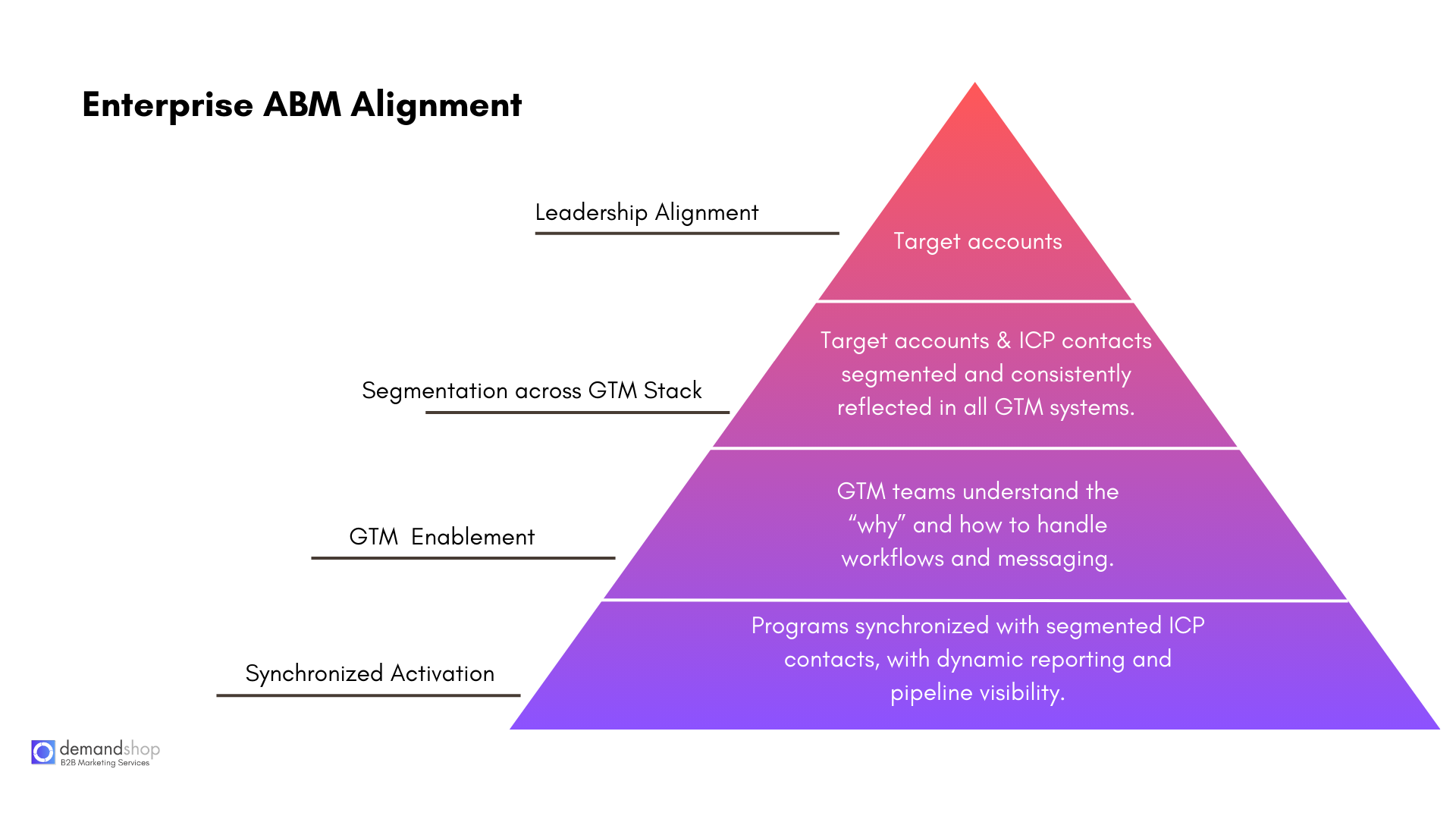
The best ABM results are from:
- Leadership alignment: Marketing + Sales leadership align on the target account strategy
- Segmentation across GTM stack: Target accounts & ICP contacts segmented and consistently reflected in all GTM systems
- GTM enablement: GTM teams understand the “why” and how to handle workflows and messaging
- Synchronized activation: Marketing and sales run coordinated programs against the same contacts with dynamic reporting
The payoff for your GTM teams:
The entire customer-facing GTM team is activated against the same accounts and the same contacts, so every touch reinforces the same motion.
2) Prioritize integrating your sales and marketing teams
Over a decade ago, sales and marketing alignment was a nice-to-have. Then, it became a requirement. But now, it’s about the quality of that integration, not just checking a box.
Alignment isn’t glamorous work — but without it, nothing else scales. Our work with Demandbase involves collaborating together through:
- Shared planning sessions, not just handoffs
- Joining sales and marketing team meetings
- Staying closely connected across SDRs, AEs, AMs, and CSMs
The payoff for your messaging:
Sales insights are shaping our messaging and influencing campaigns almost in real time.
And sometimes, that collaboration results in a request from a C-level decision-maker when you least expect it — yes, that’s happened to us!
3) Give your prospects what they *actually* want
Buyers know the old playbook: read a blog, watch a video, and you're put into a nurture sequence and getting random calls by SDRs. This model breaks down quickly when you're making multi-million dollar, multi-year deals.
Gated content has shifted away from mass-produced, generic content to a high-quality, high-intent model.
What works now is listening more closely and delivering content your buyers genuinely care about. For us, that looks like deeper, practitioner-level plays aimed at later stages of the buyer journey, directly addressing common challenges your prospect may be facing.
These are typically not top-of-funnel content like “Why your finance team needs a spend management platform” — but rather something like “How X Company protects your financial data.”
And believe it or not… eBooks still work!
For Demandbase, we focused on short playbooks designed for the key persona that we know are responsible for global GTM teams. Our simple strategy was to answer the questions they had in an easily consumable manner, knowing that they wanted and were ready to read a longer piece of content.
The payoff for content engagement:
Higher content engagement for the decision-makers in a multi-million dollar deal.
You may get pushback because it’s not high volume numbers, but you must reiterate that it’s an intentional strategy. Well-timed, tailor-made resources that directly address the problems a buying committee is actively trying to solve will always deliver — and that’s only possible with close coordination between content, product marketing, and sales teams.
Key Takeaways for modern account based marketing:
The traditional B2B tech marketing playbook has undergone some big changes, but the fundamentals still win:
- Clean and consistent segmentation
- Deep integration between sales and marketing
- A clear understanding of your buyer and their journey
When you commit to these basics, this foundation gives your team the confidence to experiment and innovate in the right places, while staying ahead in a buyer landscape that’s changing fast.