

AI upheaval has been seen before. Ada Tsang draws a direct line from touring BMW and Airbus factories during Industry 4.0 to what B2B marketers are navigating now. The lesson from supply chain holds: optimization is contextual, not universal. AI doesn't drive growth on its own. The teams that win are the ones who stay close to their customers, keep human judgment at the centre, and use AI to enhance. not replace, the work that actually builds trust.
Demand Shop’s Co-Founder Ada Tsang shares how touring manufacturing sites in 2015 shaped her marketing philosophy today.
In the next 5-10 years, it will be even clearer which parts of business can't be automated or enhanced by AI. We’re already seeing it happen: companies using AI-generated videos are getting called out by the communities they’re trying to target, and brands like Meta and Amazon already hiring back engineers they had previously laid off for AI.
There are striking parallels to what the global supply chain industry already went through a decade ago — and there’s a lot B2B marketers can learn from it. Here are are some key takeaways:
1. AI optimization is contextual, not universal
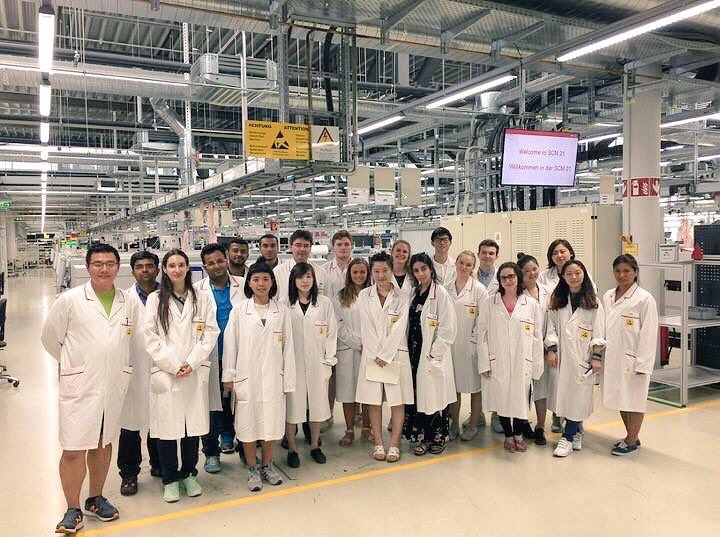
Back in 2015, Demand Shop’s Co-Founder and Head of Revenue Ada Tsang had the privilege to study abroad in Munich, Germany, touring manufacturing sites of some of the world’s most advanced companies like AirBus, BMW, and ASM. This was during Industry 4.0, the rise of automation — but interestingly, transitioning to this era was not considered a growth driver in the supply chain.
One of the sites had workers on the ground directing the robotics to grab parts from rows of huge columns and put them in the right places, so they could be moved to the next phase of the building process. At AirBus, they were building all kinds of planes — but the supply chain didn’t have any use of AI. It took years for the workers to build just one plane. Why?
The working pace was intentionally slow because of the risk involved and major QA needed for every milestone: one mistake could mean hundreds of passenger deaths. Meanwhile, the pace was much quicker at BMW, with the entire supply chain optimized between automation and people. This was possible because QA requirements for a car are much more different than an airplane.
Takeaway for B2B tech marketers:
Many B2B teams copy tactics for their funnels without strategizing for their unique audience and context. Having a deep understanding of your customers and employees is essential to building a cohesive journey — and this means knowing when to design processes that are intentionally slow and steady, to avoid risks and errors that may occur in the name of “optimization” and speed.
2. Human judgment is the real growth driver
Growth by solely cost-cutting is not growth. After several years, these manufacturers learned that AI itself doesn't necessarily drive growth, but rather leveraging AI to achieve an optimum level of efficiency alongside human specialization is what drove long-term success and profitability.
The best teams won’t be the ones who “figure out AI first” — but rather those who prioritize progress over perfection, testing and adjusting continuously, and staying close to customers and employees.
Takeaway for B2B tech marketers:
This goes back to the fundamentals of marketing: understanding your customers and the real value of your product. If you don’t, any AI solution you create or use risks being just noise.
At Demand Shop, we often hear marketing teams say "just get AI to do this," when the question should be: "should AI be doing this?"
There are undoubtedly many opportunities to use AI to scale and automate certain marketing workflows, however it's important to always remember the human component — especially in B2B, where we’re selling multi-million dollar, multi-year deals with multiple stakeholders and companies. It will be different for each business, and it will take strategic marketers to understand when to use what.
3. Company values and culture are key differentiators
These companies visited in 2015 all had key values and culture that stemmed from upper management, all the way to employees on the shop floor.
ASM has a “better together” framework, and this was evident throughout the tour and how they navigated challenges in the past: during the financial crisis, they didn’t lay off a single employee. Instead, they transformed their entire business and manufacturing floor to R&D (research and development) and testing. When the economy was on the upswing, the business was ready—and came out of the recession even stronger than before.
This success story has resonated ever since, and its people-first values have played an integral part in building our agency Demand Shop.
Takeaway for B2B tech marketers:
Marketing will be going through its own Industry 5.0 soon: a human-centric approach, with machines working alongside humans rather than replacing them.
In a few years, every marketing team will be using the same AI tools, running them the same way, and be able to get to market a lot faster while saving costs. The only way left to compete would be on your brand, your story, and how you treat the people who are part of it.